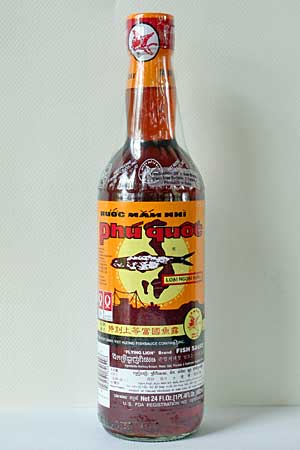
Fish Sauce
If you had to distill the essence of Vietnamese cuisine, I would say it consists of two things: fish sauce and herbs.
First off fish sauce is the liquid of fermented fish. It is sold in bottles and is available at your local Asian grocery store or Western market. Keep in mind though the Western markets usually stock bad quality fish sauce brands. The paradox of fish sauce is whe you use it, your food doesn’t taste like fish. Instead there is a different depth of umami (savoriness) in dishes.
Just like there are various qualities and brands of olive oil, the same exists for fish sauce. What ends up happening for each Vietnamese family is an eventually affinity towards one brand emerges.. My family in particular has a deep affinity towards the Phú Quốc fish sauce with the 3 flying fish on the package. This brand is more pungent and is pure fish compared to some others which have blends of shellfish.
Before proceeding, let me start with a disclaimer:
Never break a bottle of fish sauce ever
If you have a bottle of fish sauce, never ever break it. If you do this musk will linger in your house which won’t go away for many many days. Treat a bottle like you would hold a delicate baby.
Think of fish sauce as a mega concentrated ingredient. It has to be tempered and can be used in these 3 scenarios:
- It is used to marinate some type of protein
- It is used during the process of cooking a stock to add umami/salt
- It is used as a dipping sauce
Marination
You can marinate almost any protein with fish sauce. Since it is so pungent, you always need to balance it with something sweet (sugar or honey) and herbs (lemon grass, garlic, etc).
A good example of a marinate is Gà Xào Sả Ớt (stir fried chicken in lemon grass). With raw chicken you marinate it with fish sauce, a little bit of sugar, and freshly minced lemongrass from a food processor. Don’t marinate more than a day as the proteins will start to get funky.
Soups/Stews
When cooking soups and stews with a more hearty consistency, fish sauce is used in the beginning of the stock process or towards the end.
- Beef Phở (Beef Noodle Soup)
- Bún Bò Huế (Spicy Beef Noodle Soup with lemongrass)
- Cà ri gà (curry chicken with lemongrass).
With that, there are a couple of exceptions to the rule Chicken Phở actually shouldn’t have any fish sauce in the stock at all. Instead you would make a dipping sauce on the side.
Dipping Sauce
The final category use of fish sauce is to create a dipping sauce (Nước chấm). The basic concept is
- Fish sauce
- Sugar
- Acid (vinegar, lemon juice, or lime juice)
For particular dishes you would create different types of nước chấm. Examples:
- Fish - copious amounts of garlic are used for a dipping sauce
- Egg rolls - Uses the standard recipe.
Weird Things I Disagree With:
I recently ate a restaurant in Austin which served tacos. The taco had a weird funk and sparkliness to it. I asked the waiter if it had fish sauce, and he said yes, and as a finisher. To me this was a totally disgusting way to use fish sauce. The big mistake here was that the fish sauce should either have been created as a dipping sauce (Nước chấm), or not at all.
Vegetarian Alternatives:
Unfortunately to this day, I personally haven’t found any good vegetarian alternatives. I’ve heard some of some people using liquid aminos, but it doesn’t seem the same.
I’m excited to see how chefs will continue to use fish sauce in the future.